There were five browser tabs open on a founder’s desk. A chat assistant, an image generator, a design tool, a writing tool — all of them paid subscriptions. And he told me a single product detail page still took him a week.
Those two facts sound like a contradiction. So many tools, and nothing gets faster. I think the answer sits inside the contradiction, because I have seen the same thing at other companies.
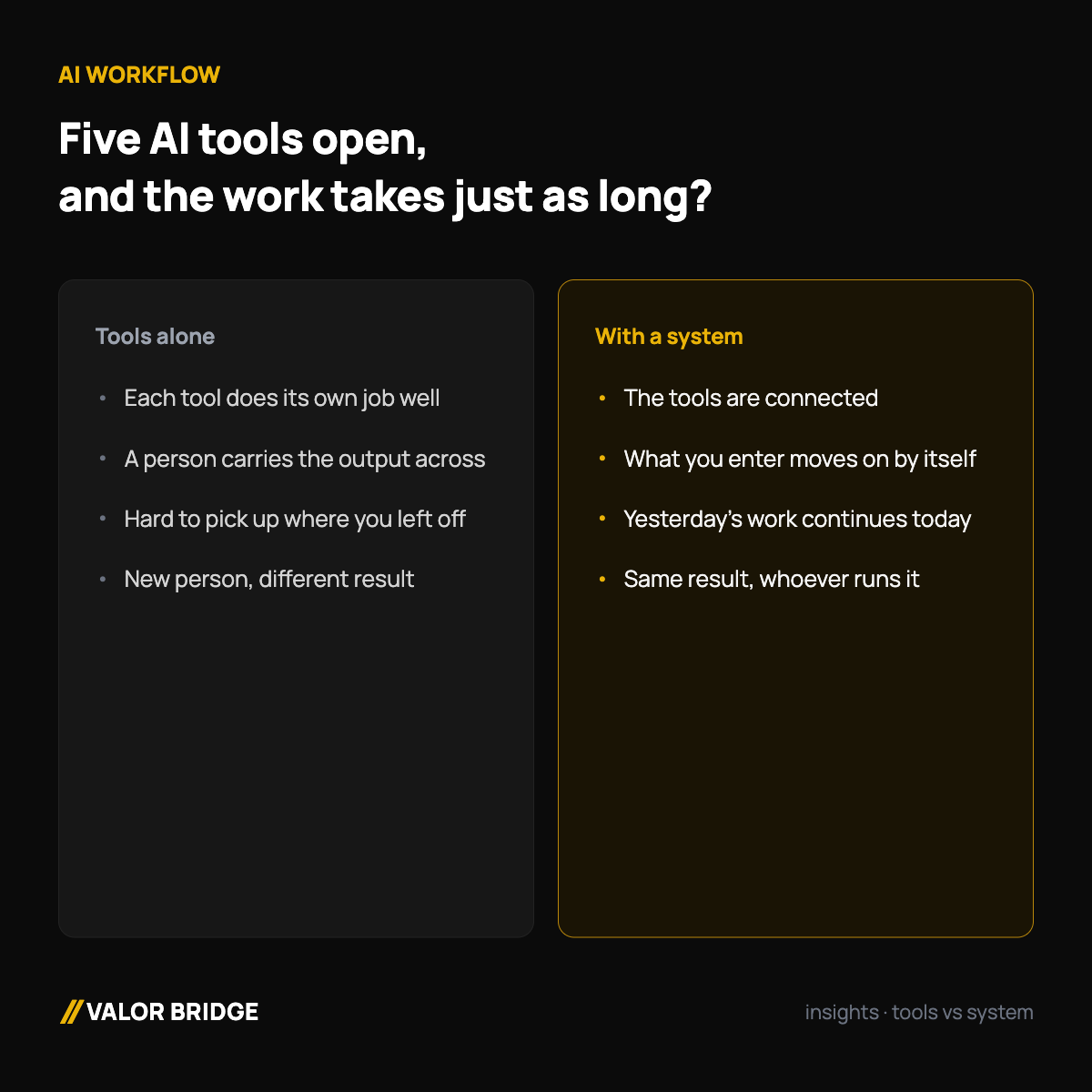
The first was a company that imports cosmetic ingredients and manufactures in Korea. The founder put it himself: "It is all split up. I keep going through six or seven steps." Pull the copy out of a chatbot, feed it into an image tool, carry the finished pieces over into a design tool. Each tool does its own job admirably. The problem was the stretch in between, where a person copies the output by hand and carries it to the next tool. That stretch appears on no quote and no process chart. And most of the day was disappearing into it.
The second is my own company. In the trading business I used to run, making one product catalogue was written down as "four or five hours, nominally" — and in practice it ate the whole day. When I took it apart, the problem was not a shortage of hours. Every time I switched tools I had to set my own head up again. The industry calls this context switching. What it felt like to me was my brain being tied to something and coming to a stop.
The third was a manufacturer of environmental equipment, and there it wore a different face. The person handling their social content told me the repetitive work itself was not the hard part. The hard part was starting from a blank page every time. She was running everything off one template a predecessor had left behind, and she could not get outside it. The tool was there; the tool just does not offer you a new format on its own. For that one we changed direction: instead of handing over one finished piece, we built several layout options she could choose from. Not removing the repetition — removing only the blank page at the start of it.
And this next one is not about any single company. I have heard it over and over: "At some point the thing wanders off." Once there is data already loaded in, starting over becomes nearly impossible. I do not think this is a question of how good the AI is. It is structural: when a conversation ends, the context built up inside it ends with it. Work is not slow because the tools are lacking. It is slow because the space between one tool and the next — the stretch where a human carries the material across — is empty.
Four companies, four industries, and the pain showed up wearing a different face at each. But take it apart and the same place was empty. The space between the tools. If each tool is a machine on a factory floor, every machine is new and there is no conveyor between them. Someone has to pick up the half-finished product and walk it to the next machine. Buy one more excellent machine and you have added one more stretch to walk. Each purchase, taken on its own, is a sound decision. Repeat that sound decision a few times and the floor fills up with gaps no conveyor covers.
A system removes the carrying. Information you enter once moves to the next step by itself. So these days, instead of asking how many tools a company uses, I start by asking how material crosses from one tool to the next. Not many companies can answer straight away. Most stop at "uh... we just copy and paste." I think the answer is itself the signal. Copy and paste means someone is already standing in that gap, carrying things.
So before adding one more tool, I would suggest asking these three questions first.
One. Does what this tool produces pass automatically to the next tool, or does a person copy it across? If a hand is doing the carrying, that is your missing conveyor.
Two. Can you open yesterday’s output today and carry on from it, or do you start fresh each time? If you start fresh each time, it is not the tool doing the work — it is the session.
Three. Does a different person using this tool get the same result, or is there a knack that lives only in one person’s head? If the knack lives in a head, the work stops the moment that person steps away.
If all three answers are close to no, I think it is right to look at the gaps before adding another tool. Whether that is the correct order for every company I honestly cannot say. It has been true of the ones I have seen so far. None of this means the tools are bad. It is just that buying more tools and connecting the ones you have are entirely different decisions — something I find myself relearning every time.